About
The AVN Institute of Engineering and Technology (AVNIET) proudly established Centre of Excellence in Robotics and Drone Technologyto promote innovation, education, and research in the field of autonomous systems.This cutting-edge center serves as an experiential learning space where students actively engage in designing, building, and programming advanced robots and unmanned aerial vehicles (UAVs) for practical applications in surveillance, precision agriculture, and disaster response. Equipped with the latest tools, simulators, and embedded system kits, the facility empowers learners to gain real-world technical skills through hands-on experience.By encouraging interdisciplinary collaboration and fostering strong industry partnerships, the center nurtures creativity, problem-solving, and technical excellence. It plays a vital role in preparing the next generation of engineers for careers in automation, aerial robotics, and intelligent systemssupporting the national vision of Digital India and the global thrust towards Industry 4.0.
Vision & Mission
Vision
To become a nationally recognized hub of excellence in robotics and drone technologies, driving innovation, interdisciplinary research, and skill development to empower future-ready engineers and contribute to the advancement of autonomous systems for societal benefit.
Mission
- To foster a culture of hands-on learning, creativity, and innovation in the fields of robotics and UAV technologies.
- To provide state-of-the-art infrastructure and resources for students and researchers to design and develop intelligent autonomous systems.
- To collaborate with industry, academia, and government bodies to address real-world challenges in surveillance, agriculture, disaster management, and more.
- To support national initiatives like Digital India, Skill India, and Industry 4.0 by nurturing talent equipped with future-ready technological skills.
Objectives
- To offer experiential learning opportunities in robotics and drone technology through project-based education and live simulations.
- To conduct workshops, seminars, and certification programs that enhance technical proficiency and innovation capacity.
- To encourage interdisciplinary research and student-led innovations that solve pressing societal and industrial problems.
- To establish strong linkages with industry leaders and research organizations for knowledge exchange, internships, and collaborative projects.
- To incubate innovative ideas and support entrepreneurship in the domain of autonomous and intelligent systems.
- To contribute to the national and global technological ecosystem by producing skilled professionals and thought leaders in robotics and UAV applications.
Expert’s Team
| S.No. | Faculty- Expert Name | Designation | Roles in |
|---|---|---|---|
| 1 | Dr. P. Nageswara Reddy | Principal | Chairperson |
| 2 | Dr. Dhanalakshmi Gopal | Head-R&D, | Convener |
| Professor, ECE | |||
| 3 | Dr. N. Suresh | Professor & Head – ECE | Member |
| 4 | Dr. Indra Priyadarshini | Professor/CS | Member |
| 5 | Dr.B. Shilpa | Asst. Professor, CSE | Member |
| 6 | Dr. Ramesh Babu | Asst. Professor, AI&ML | Member |
| 7 | Mr. K. Ramesh | Asst. Professor, ECE | Member |
| 8 | Mr. M. Sharath Chandra | Asst. Professor, ECE | Member |
| 9 | Mr. J. Venkatesh | Asst. Professor, ECE | Member |
| 10 | Ms. Jyothi | Asst. Professor, AI&ML | Member |
| 11 | Mr.Chandra Sheker | Asst.Professor, CSE/AIML | Co-ordinator |
Facilities
| Category | Component | Quantity | Purpose |
|---|---|---|---|
| Microcontrollers | Arduino Mega / UNO | 15 | Robotic control, sensor interfacing |
| Raspberry Pi 4 / Jetson Nano | 10 | Vision processing, edge AI | |
| Robotics Kits | DIY Robotics Kits (Line follower, Obstacle avoider) | 10 sets | Basic learning, motion control projects |
| Programmable Robotic Arms | 3–5 | Pick-and-place, automation projects | |
| Humanoid Robot Kits | 2 | Research & educational demonstrations | |
| Motors & Drivers | DC Motors, Servo Motors, Stepper Motors | Assorted | Actuation for robots and drones |
| L298N, L9110, DRV8825 Motor Driver Modules | 20+ | Motor control and direction | |
| Sensors | Ultrasonic Sensors (HC-SR04) | 15 | Obstacle detection for robots/drones |
| IR Sensors, Line Tracking Modules | 20+ | Path-following and edge detection | |
| IMU (MPU6050, MPU9250) | 15 | Orientation, balance for drones and bots | |
| GPS Modules (NEO-6M) | 5–10 | Navigation and mapping | |
| Drone Components | Brushless Motors (e.g., 2212/920KV) | 20+ | Multirotor propulsion |
| ESCs (Electronic Speed Controllers) | 20+ | Motor control in drones | |
| Propellers (CW & CCW) | 30+ pairs | Drone lift and stability | |
| Drone Frames (250mm, 450mm) | 10 | Building drones | |
| Flight Controllers (KK2.1.5, APM, Pixhawk) | 10 | Drone stabilization and control | |
| Li-Po Batteries (11.1V, 3S, 2200mAh) | 10+ | Power source for drones | |
| Battery Chargers, Balancers | 5+ | Safe and efficient charging | |
| Communication | RF Modules (NRF24L01, 433 MHz) | 10+ | Remote control communication |
| Telemetry Modules (e.g., 3DR 915MHz) | 5 | Ground-to-drone data communication | |
| Wi-Fi / Bluetooth Modules (ESP32, HC-05) | 20+ | Short-range communication | |
| Cameras & Vision | Pi Cameras / USB Cameras | 10 | Computer vision, surveillance |
| OpenCV-compatible cameras | 5 | AI-based image processing | |
| Gimbal Stabilizer Modules | 3 | Stabilized imaging on drones | |
| Ground Equipment | Transmitter & Receiver Kits (6-CH/10-CH) | 5 sets | Drone & robot remote control |
| Simulation Software (Gazebo, MATLAB Robotics Toolbox) | — | Algorithm development and simulation | |
| FPV Goggles / Monitors | 3 | Real-time drone video feed | |
| Power & Tools | Power Supplies (5V, 12V, adjustable) | 10+ | Bench testing and prototyping |
| Multimeters, Soldering Stations, Hot Air Guns | 5 each | Assembly and troubleshooting | |
| Li-Po Safety Bags, Fire Extinguishers | As needed | Battery safety and handling | |
| Assembly & Lab Setup | Screwdriver Sets, Calipers, Pliers | Multiple | Hardware assembly |
| Drone Launch Area / Indoor Net | 1 setup | Safe test flights | |
| Charging Station Rack | 1 setup | Battery management | |
| ESD Mats, Anti-static Wrist Straps | As needed | Safety during handling |
e-Yantra Robotics Lab
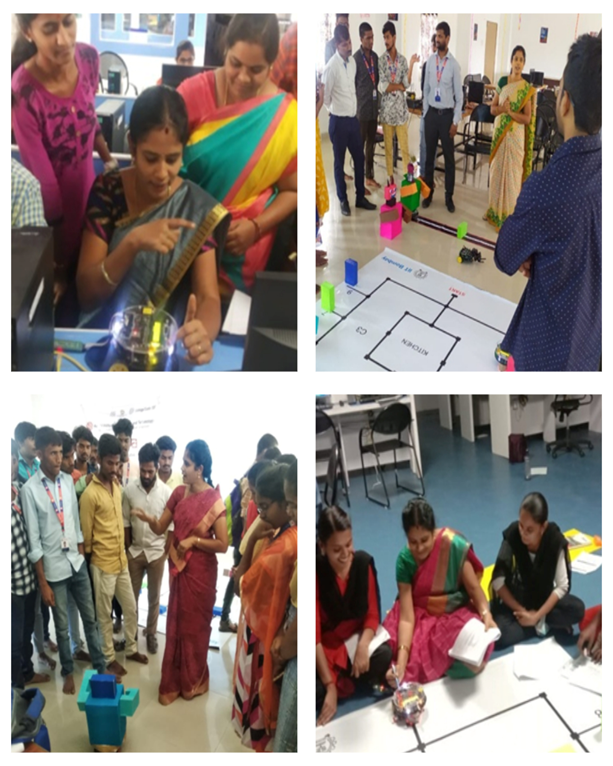
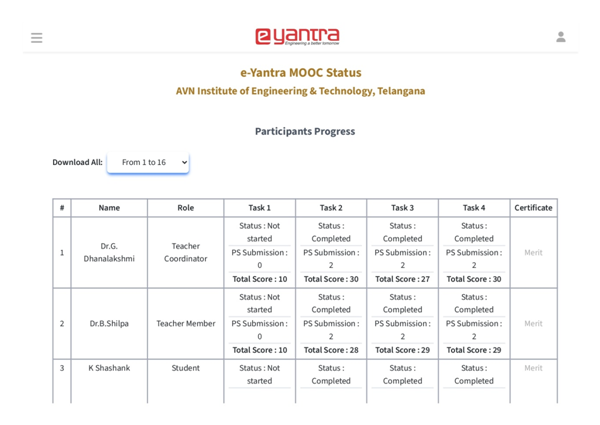
The institution has established an e-Yantra Robotics Lab in association with the Indian Institute of Technology (IIT) Bombay under the e-Yantra initiative.
The lab aims to promote robotics education and embedded systems learning through hands-on training, project-based learning, and problem-solving activities. It enables students to design, program, and implement robotic systems using real-time hardware platforms.
Through this collaboration, students gain exposure to advanced technologies in robotics, automation, embedded systems, and control systems, enhancing their technical competence and innovation capabilities.



Activities
AVNIET organized a workshop on Advancements in UAVs and Development of Drone Applications using AI, focusing on responsible drone usage, regulatory compliance, and safety protocols. Participants gained insights into DGCA guidelines, privacy concerns, and airspace restrictions. The session aimed to raise awareness about ethical deployment of drone technology in civil, academic, and industrial applications.

Events