

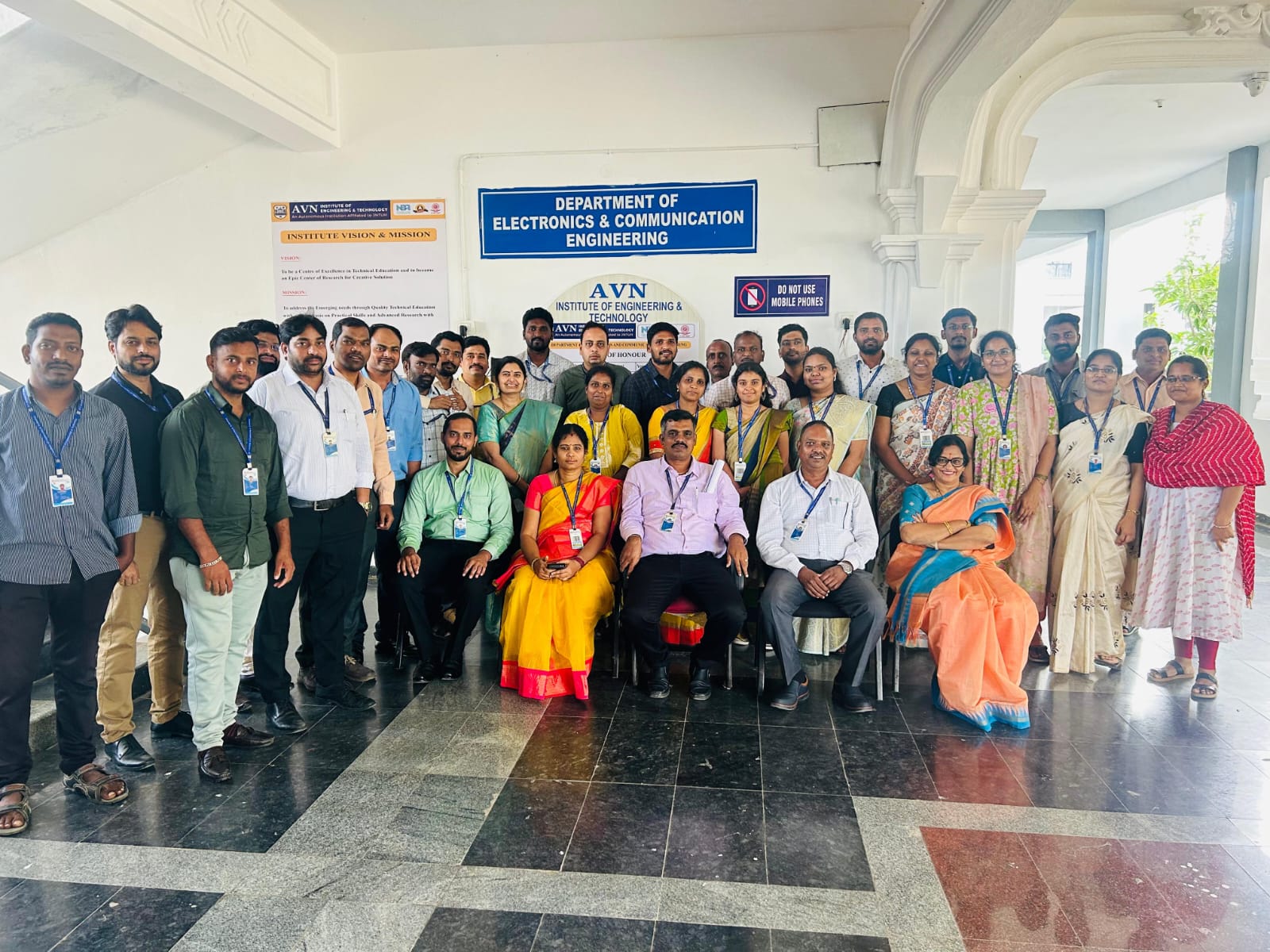
The Department of Electronics and Communication Engineering (ECE) at AVN Institute of Engineering and Technology was established in 2009 along with the inception of the institution. Since its establishment, the department has been dedicated to providing quality technical education, fostering innovation, and producing skilled engineers capable of meeting the challenges of the rapidly evolving electronics and communication industry.
The department commenced its journey with an initial intake of 60 students in the B.Tech. program and subsequently expanded to an intake of 120 students in response to the growing demand for ECE professionals and advancements in technology. To promote higher education and research, the department introduced the M.Tech. program in VLSI & Embedded Systems (VLSI & ES) with an intake of 12 students.
The department emphasizes academic excellence, industry-oriented learning, research, innovation, and professional development, enabling students to excel in both core engineering and interdisciplinary domains.
Current Intake
Program | Intake |
B.Tech. Electronics and Communication Engineering | 120 |
M.Tech. program in VLSI & Embedded Systems (VLSI & ES) | 12 |
Department Highlights
- State-of-the-art laboratories equipped with modern hardware and software tools.
- Highly qualified and experienced faculty members.
- Industry-oriented curriculum aligned with emerging technologies.
- Strong focus on research, innovation, internships, and project-based learning.
- Regular organization of workshops, seminars, guest lectures, and industrial visits.
- Active participation of students in technical competitions and professional society activities.
- Excellent mentoring and career guidance support.
- Encouragement for entrepreneurship, innovation, and patent-oriented research.
Focus Areas of the Department
- Wireless Communications and 5G/6G Technologies
- Advanced mobile communication systems, network optimization, and next-generation wireless technologies.
- VLSI Design and Semiconductor Technology
- Chip design, ASIC/FPGA development, verification, and semiconductor manufacturing technologies.
- Embedded Systems and Edge Computing
- Design and development of intelligent embedded solutions for real-time applications.
- Internet of Things (IoT) and Smart Systems
- Connected devices, smart cities, smart healthcare, and industrial IoT applications.
- Artificial Intelligence and Machine Learning
- AI-driven solutions for communication, signal processing, automation, and intelligent decision-making.
- Signal, Image, and Video Processing
- Processing and analysis of multimedia signals for healthcare, surveillance, and communication applications.
- Robotics and Industrial Automation
- Intelligent robotic systems, autonomous platforms, and Industry 4.0 technologies.
- Cyber-Physical Systems and Smart Manufacturing
- Integration of physical systems with computational intelligence for advanced industrial applications.
- Biomedical Electronics and Healthcare Technologies
- EEG, ECG, wearable devices, telemedicine, and AI-assisted healthcare systems.
- Sustainable Electronics and Green Technologies
- Energy-efficient electronic systems, renewable energy integration, and environmentally sustainable engineering solutions.
